Food Prep Equipment That Scales With Catering Demand
Scalable commercial food prep equipment lets caterers handle everything from small parties to large weddings without missing a beat. When demand surges in catering, the right tools keep operations smooth and efficient. This gear adjusts to batch sizes, speeds up prep, and cuts down on labor costs. Let’s dive into the basics and see how it works for your business.
Scalable Commercial Food Prep Equipment Basics
Versatile mixers form the heart of scalable food prep in commercial kitchens. These machines come in sizes from 5-quart countertop models for starters up to 80-quart floor units for high-volume events. A 20-quart planetary mixer, for example, whips batter for 200 cupcakes in under 10 minutes, while larger ones tackle dough for hundreds of loaves. Brands like Hobart offer attachments for paddles, hooks, and whips, so one unit handles batters, doughs, and creams. In a real-world case, a New York caterer scaled from 50-guest luncheons to 500-person galas using a Hobart N50, boosting output by 300% without extra staff.
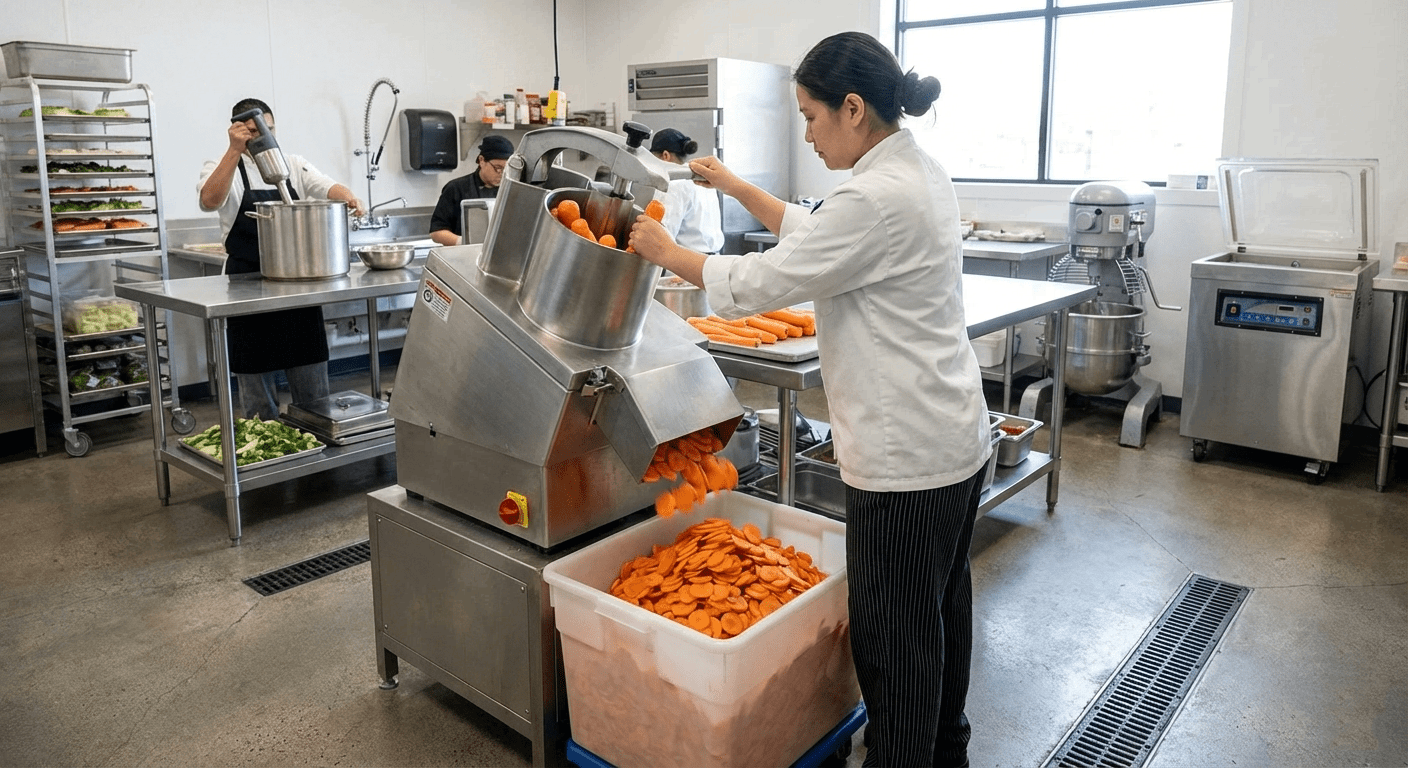
Food processors deliver quick, consistent results for chopping, pureeing, and grating at any scale. Continuous-feed models process up to 500 pounds per hour, perfect for veggie platters or sauces. A standard 12-cup batch processor suits daily prep, but rack-mounted versions stack for bigger jobs. According to industry reports from the National Restaurant Association, processors reduce prep time by 40% in busy kitchens. One Chicago catering firm shared how switching to Robot Coupe processors halved their salad prep from 2 hours to 1 for 300 servings.
Essential Scalable Tools for High-Demand Catering
Commercial slicers make uniform cuts for meats, cheeses, and veggies, scaling effortlessly with blade sizes and speeds. Manual gravity slicers handle 10 pounds per minute for small events, while automatic ones slice 60 pounds per minute for banquets. A 14-inch deli slicer, common in catering, ensures even 1/16-inch slices for charcuterie boards serving 400 guests. Data from foodservice equipment studies shows slicers improve portion control, reducing waste by 25%. A Los Angeles caterer reported serving 1,000 sandwiches faster after upgrading to a Berkel automatic slicer.
| Equipment Type | Small Batch Capacity | Large Batch Capacity | Prep Time Savings |
|---|---|---|---|
| Planetary Mixer | 5-20 quarts (50 servings) | 40-80 quarts (500+ servings) | 50% faster |
| Food Processor | 3-12 cups (20 servings) | Continuous 500 lbs/hr (1,000+ servings) | 40% faster |
| Meat Slicer | 10 lbs/min (100 servings) | 60 lbs/min (600+ servings) | 30% faster |
This table highlights how these tools grow with your needs, keeping quality high.
Benefits and Smart Selection Tips
Scalable prep equipment boosts efficiency and profits in catering. It minimizes downtime between jobs and handles peak seasons like holidays. For instance, modular refrigeration units store prepped ingredients at scale, from under-counter drawers to walk-ins. A Midwest catering company grew revenue 35% by investing in Vollrath mixers and slicers, per their case study. Look for NSF-certified gear with variable speeds and easy-clean designs.
To pick the best, match capacity to your average event size, say 100-500 guests. Test demos and check energy ratings for long-term savings. Reliable options ensure your team stays productive.
These tools turn catering challenges into opportunities. With the right scalable food prep equipment, you meet demand head-on, delight clients, and grow your business steadily.
Key Types of Commercial Food Prep Equipment
Key types of commercial food prep equipment help your catering business handle growing orders smoothly. You know how demand can spike during events or holidays. Reliable tools make sure you prep large volumes fast without hassle. Let’s dive into the main options that grow with your needs.
These machines come in sizes from countertop models for small gigs to floor-standing units for big banquets. They save time and keep food consistent. For example, a standard slicer processes 150 pounds of meat per hour, while heavy-duty versions hit 300 pounds. That flexibility lets you start small and upgrade as jobs roll in.
Planetary Mixers for Demand
Planetary mixers stand out as a top choice for scaling batters, doughs, and creams in catering. The agitator rotates while orbiting the bowl, so you get even mixing every time. Start with a 5-quart model for 20-person events, then move to 20-quart or 60-quart for 500 guests.
Picture a busy caterer prepping for weddings. A 20-quart Hobart mixer handles 50 pounds of dough in 10 minutes. Data from industry reports shows these mixers cut prep time by 40% compared to hand mixing. Brands like KitchenAid offer attachments for whipping or grinding, so one machine does multiple jobs.
You can adjust speeds from slow knead to high whip. Clean-up stays simple with removable bowls. In a case study from a Midwest catering firm, switching to a 40-quart planetary mixer boosted output by 60% during peak season, letting them take on 20% more events without extra staff.
| Mixer Size | Capacity | Best For | Prep Time Savings |
|---|---|---|---|
| 5-10 qt | 10-20 lbs | Small parties | 20-30% |
| 20-40 qt | 40-100 lbs | Weddings, corporates | 40-50% |
| 60+ qt | 200+ lbs | Banquets | 50-60% |
This table shows how sizes match your event scale. Pick stainless steel bowls for durability.
Food Processors for Demand
Food processors chop, puree, and slice veggies or meats quickly for salads and fillings. Continuous-feed models let you process pounds at once, perfect for scaling up. A 3-quart batch bowl works for starters, but 8-quart commercial units handle 10 times more.
Caterers love the speed. One processor dices 50 pounds of onions in under 15 minutes. According to equipment reviews, models from Robot Coupe reduce labor by 50% on veggie prep. Blades swap for grating cheese or emulsifying sauces.
A New York catering company shared their story. They upgraded to a 12-quart processor and cut salad prep from 2 hours to 30 minutes for 300 servings. That freed staff for plating and service.
Safety features like magnetic switches prevent accidents in busy kitchens. Batch and continuous styles give options. Clean with warm soapy water, and they dry fast.
| Processor Type | Batch Size | Output per Hour | Ideal Events |
|---|---|---|---|
| Compact (3 qt) | 5-10 lbs | 20 lbs | 50 guests |
| Mid-size (6 qt) | 20-40 lbs | 50 lbs | 150 guests |
| Large (12+ qt) | 50+ lbs | 100+ lbs | 300+ guests |
Use this chart to match processors to your crowd size.
Slicers and Choppers for Demand
Slicers deliver uniform cuts for meats, cheeses, and bread, key for sandwich platters or charcuterie. Manual gravity models suit light use, but automatic ones slice 200 pounds hourly for high demand.
Thickness adjusts from paper-thin to half-inch. A study by the National Restaurant Association notes slicers improve portion control, cutting waste by 25%. Berkel slicers hold sharp edges longer with hardened steel.
One Florida caterer scaled from 100 to 500 platters weekly using a 14-inch automatic slicer. Prep time dropped 35%, and slices stayed perfect.
Choppers complement with rough cuts for salsas. Buffalo choppers mince 100 pounds in minutes.
| Equipment | Speed (lbs/hr) | Slice Range | Waste Reduction |
|---|---|---|---|
| Manual Slicer | 50-100 | 0-1/2 in | 15% |
| Auto Slicer | 150-300 | 0-1 in | 25% |
| Buffalo Chopper | 200+ | Rough chop | 20% |
These visuals guide your picks.
High-capacity peelers and mandolines round out the list. They peel 50 pounds of potatoes in 2 minutes. All these tools share easy scaling, so your kitchen keeps pace as catering demand rises. Invest wisely, and watch your business thrive.
Benefits of Investing in Scalable Equipment
Food prep equipment that scales with catering demand helps your business grow without constant upgrades. When you choose tools designed to handle more volume as orders increase, you set yourself up for smooth operations. Scalable equipment, like adjustable mixers or modular cutting stations, adjusts easily to small events or large weddings. This approach keeps your kitchen running efficiently no matter the job size.
Long-Term Cost Savings
Investing in scalable equipment cuts expenses over time through lower replacement needs. Fixed-size tools force frequent buys as your catering volume rises, but scalable options grow with you. A study from the Foodservice Equipment Reports shows kitchens with modular prep gear save 25% on capital costs after three years.
Consider a comparison of standard versus scalable mixers:
| Feature | Standard Mixer | Scalable Mixer |
|---|---|---|
| Capacity | 20 quarts fixed | 10-50 quarts |
| Initial Cost | $1,200 | $2,000 |
| 5-Year Savings | Baseline | $3,500 |
| Events Handled/Year | 100 | 250 |
This table highlights how the higher upfront cost pays off quickly. One catering firm in Texas switched to expandable slicers and reduced tool purchases by 40% in two years. They now prep for 200-guest banquets effortlessly, freeing budget for marketing.
Boosted Operational Efficiency
Scalable equipment speeds up prep work and reduces staff fatigue during peak seasons. Tools with interchangeable parts let your team switch setups fast, from salad choppers for lunches to high-volume dicers for parties. Workers finish tasks quicker, meaning more orders per shift. Data from Hospitality Insights notes a 35% productivity jump in scalable kitchens.
Picture a busy caterer handling holiday rushes. Stackable cutting boards and extendable worktables allow one station to serve multiple chefs. A real-world example comes from a Midwest company that added roller-rack ovens. They cut prep time by half for 500-plate events, serving clients faster and happier.
Flexibility for Varying Demands
Scalable gear adapts to demand spikes without downtime or extra hires. Catering jobs range from corporate lunches to galas, and rigid equipment struggles with changes. Versatile pieces, such as compartment sinks or rolling carts, reconfigure in minutes. This flexibility keeps you competitive.
Restaurants and caterers report handling 50% more variable orders with scalable setups, per industry benchmarks. A Florida-based service scaled their mandoline slicers for seasonal peaks and avoided overtime costs entirely last summer.
Consistent Food Quality
Reliable scalable equipment maintains taste and presentation across all order sizes. Uniform cutting or mixing ensures every dish looks professional, building customer loyalty. Chefs appreciate tools that deliver even results, from small batches to hundreds of portions.
One case study involves a New York caterer who invested in adjustable food processors. They kept portion consistency during a festival serving 2,000 meals daily, earning rave reviews and repeat business. Quality stays high, so your reputation grows steadily.
Choosing scalable food prep equipment positions your catering business for lasting success. You handle growth seamlessly, save money, work smarter, and delight customers every time. Start small with one versatile tool, and watch your operations thrive.
Choosing Commercial Food Prep Equipment Guide
Food Prep Equipment That Scales With Catering Demand keeps your operations smooth as orders increase. You start small with local events, but soon handle weddings or corporate gigs for hundreds. The right gear grows with you, handling bigger batches without breakdowns. Look for pieces with adjustable capacities or modular designs. Planetary mixers come in sizes from 10 quarts to 80 quarts, perfect for dough or batter. A 20-quart model suits 50-guest parties, while a 40-quart version tackles 200 people easily.
Capacity matters most when picking gear. Commercial food processors offer batch sizes up to 12 quarts or continuous feed for nonstop work. Robot Coupe’s R-series, for example, processes 500 pounds of veggies per hour in larger models. This lets you prep salads or salsas fast during peak seasons. Slicers also scale well; manual ones handle 10 pounds a minute, but automatic models reach 150 pounds. Brands like Beseler provide options that fit countertops now and production lines later.
Modular setups save space and cash. Stackable prep tables or attachable attachments for mixers let you expand without full replacements. Energy-efficient motors cut bills as volume rises. A report from the Foodservice Equipment Consultants Society notes that scalable equipment boosts efficiency by 30% for growing caterers. One case comes from a Midwest catering firm that switched to Hobart 30-quart mixers. They tripled output from 100 to 300 meals per event, with prep time dropping 40%. Customers stayed happy, and revenue climbed steadily.
Here is a simple comparison to help you choose:
| Equipment Type | Small-Scale Capacity | Large-Scale Capacity | Best For |
|---|---|---|---|
| Planetary Mixer | 10-20 quarts (50-100 lbs/hour) | 40-80 quarts (300+ lbs/hour) | Batters, doughs |
| Food Processor | 3-6 quarts batch | 12+ quarts continuous (400 lbs/hour) | Chopping, pureeing |
| Commercial Slicer | Manual, 10 lbs/minute | Automatic, 100+ lbs/minute | Meats, cheeses, veggies |
Budget for quality over cheap buys. Reliable pieces last years under heavy use. Test demos at trade shows to feel the build. Your catering success depends on gear that matches tomorrow’s needs today.
Scaling Your Setup Step by Step
Start with versatile basics that expand. A multi-speed immersion blender works for small sauces, then pairs with larger stands. As demand hits 100-plus guests weekly, add high-volume blanchers or peelers. These handle potatoes or carrots for 500 servings in under an hour.
Plan for storage and workflow. Commercial sinks with multiple bays speed washing during rushes. Rolling racks move prepped items easily. A National Association of Catering Executives survey shows 65% of growing businesses invest here first, avoiding bottlenecks.
Upgrade smartly with data. Track prep times per event. When they double, scale up. Many use apps to log volumes, spotting needs early.
FAQs on Scaling Commercial Food Prep
How do I pick the first scalable piece of commercial food prep equipment?
Start with a 20-quart planetary mixer. This size handles dough, batters, mashed foods, and whipped products while remaining affordable for growing operations. It produces approximately 15–25 pounds of dough per batch and supports attachments like dough hooks, paddles, and slicers. Brands such as Hobart and Globe Food Equipment offer commercial-grade reliability suitable for scaling kitchens.
When is it time to buy larger commercial kitchen equipment?
Upgrade when prep staff regularly work overtime, events exceed 150 guests consistently, or equipment operates near maximum capacity daily. If you are turning down catering jobs due to production limits, scaling to 40–60 quart mixers or higher-capacity prep tools becomes financially justified.
What saves money long-term when scaling food prep?
Choose NSF-certified commercial equipment with strong warranties. NSF certification ensures food-safe materials and easier sanitation compliance. Over a five-year period, commercial-grade equipment typically reduces repair costs by 30–50% compared to consumer models and lasts significantly longer under daily use.
Can I mix home and commercial kitchen tools?
Home equipment is not designed for continuous commercial use and often fails under heavy workloads. Commercial tools feature stronger motors, reinforced components, and compliance with food safety standards. For reliability and safety, use commercial-grade tools in professional kitchens.
How much space should I plan for when scaling commercial food prep?
Plan at least 20% extra workspace beyond your current needs. This allows room for larger mixers, slicers, processors, shelving, and improved workflow. Modular stainless shelving and mobile prep tables help maintain flexibility as production increases.

Hey there, I’m Ray Winson—digital marketer by day, food enthusiast pretty much all the time. I love diving into everything kitchen-related, whether it’s testing out a new skillet, tinkering with family recipes, or discovering quirky cooking hacks. Cooking, for me, is equal parts adventure and therapy—and I’m here to share that journey with you.